
An interview with Laura Jenkinson-Brown, AKA Greek Myth Comix
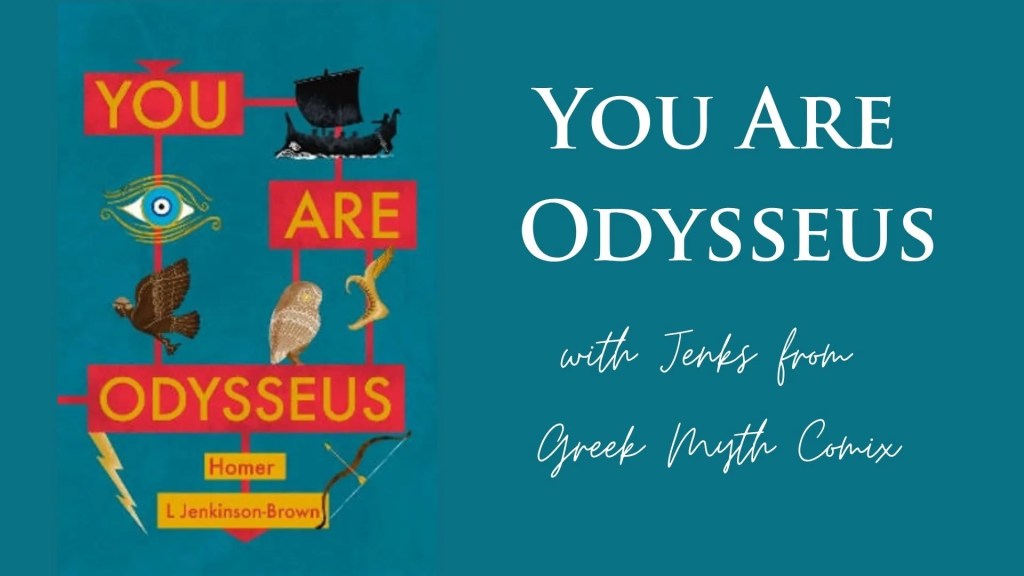
A year on from the publication of her choose-your-own-adventure adaptation of the Odyssey, You Are Odysseus, Laura Jenkinson-Brown – award-winning author, illustrator and teacher – spoke to our Outreach Officer Declan about her inspirations, writing process and future projects.
What do you remember about your first encounter with the Odyssey?
I think I must have had a children’s book of Greek Myths (I was a bit of a precocious reader) and we must have done some of it at A-Level, because when at university the final exam for the ‘Art and Myth’ component on my Classics with English course had an unexpected question – on ‘the role of women in the Odyssey’, which we had not studied as part of the module – I was still able to answer the question. I did have a copy of the text, from the Reading List, but I don’t think I was asked to read it. But back then I was very much a Victorian literature nerd and it wasn’t until I started teaching Classical Civilisation – which happened rather by happy accident, as I’d trained to be an English teacher – that I started to really appreciate it. I was teaching the Iliad at A-Level and then we started teaching the Odyssey module at GCSE, and Homer became my life. The literary features just did for me. I was like an architect looking at the very first blueprint.
Why did you choose to adapt the Odyssey and how did this particular book come about?
It was, in fact, my husband’s idea. He’s not a classicist, but within six months of us meeting he’d listened to audiobooks of the Iliad, the Odyssey and even the Aeneid, and has always been the most supportive of all my projects. We were staying at a house with friends for a wedding, and reading a book we’d found, Choose Your Own Apocalypse by Rob Sears, which was a fantastic, topical throwback to our favourite Choose Your Own Adventure and Fighting Fantasy books of childhood. I was teaching Homer and probably talking about how Odysseus makes lots of choices in the text. My husband said, ‘What if you did a choose-your-own version of the Odyssey?’ And I picked up a sheet of paper and started seeing if I could plot it out.
What are the most exciting and the most challenging parts of writing a choose-your-own-adventure book?
Well, first, the title: the Choose Your Own people (ChooseCo) are rather litigious! So, I didn’t use the name. But essentially it’s a choose-your-own-path book: the story branches off as you make each choice. In the Odyssey, particularly the narrative sections (Books 9–12), Odysseus is presented, or presents himself, as having to make choices: ‘he communed with his great heart’ or ‘his mind turned this way and that’ are the kind of formulaic translations that indicate this in the text. In the opening he is described as polytropos, which has been translated as ‘many-turning’ and ‘complicated’ and so forth. These choice sections, mostly in line with where he makes choices in the text, are great at helping students understand the character of Odysseus, which is an important aspect of study. I realised that being able to offer alternative storylines where he makes the other decision, storylines that reflect the culture and events of both the supposed Bronze Age setting and the other mythology that surrounds the characters or that is contemporaneous with the Iliad and Odyssey storylines, would be highly beneficial to a class of curious students.
I started with those alternative choices, as they gave me more freedom to write. Then went back and fleshed out the ‘correct’ choice branch by turning the text into a second-person narrative and adding in more sensory details whilst trying to remain really true to my beloved narrative features of the original. That was really exciting, seeing the Odyssey’s events through this other lens.
The real main challenge was, of course, keeping all the sections together and keeping track of the branches. I realised early on that I wasn’t going to be able to do that on my own – I am dyscalculic for a start, meaning that I often remember numbers incorrectly or backwards which would be a bit of a hindrance in a number-based system – so I searched and found an old piece of software designed for choice-based gaming that I was able to use.
The other most challenging part was editing – the book ended up being over 700 pages long, and I started writing it on a very old laptop keyboard with sticky keys so there were an awful lot of typos and missing words that regular spell check and grammar check just ignored. It was a mammoth close-reading task, and worrying what mistakes I’ve overlooked and left in keeps me awake at night! I’d have loved to have an editor.
Did you have a go-to translation you used for adapting the Odyssey, or was it important to you to consult a range?
I had four that I used. I always go back to E V Rieu’s prose translation, as that’s the one I learned on and taught with originally, but I also already had a Lattimore from university, and the Wilson translation, which I’d picked up in a beautiful bookshop on Santorini. I tended to flit between those at first, comparing translations of specific sections or similes, and coming back to the Rieu for plot points. The Poetry in Translation project’s translation by A S Kline, which is also a suggested text for GCSE (because it’s free and thus accessible) was also great for when I didn’t have a text to hand and suddenly needed to check something on the bus. I collected several more editions while I was researching, and now I have something like nine or ten, if you count comics and graphic novels. It also helped me make sure I was writing in my own voice if I wasn’t just reading one translation constantly. In total I probably used eight of these for research. I particularly like the W D Rouse, very Boys’ Own Adventure!
Some parts of You Are Odysseus engage with material from outside the Homeric poems, such as the heated encounter between Odysseus and Diomedes shortly after leaving Troy, and the inclusion of Odysseus’ sons with Circe and Calypso. How did you choose which sources to use beyond the Homeric texts, and were there any sources you purposely chose to reject in your retelling?
This was honestly just an excuse for me to read and research more. I’ve always regretted not getting into epic and mythology more at university, when I’d have had time to really dig into it, so this was my chance! I got a copy of Gantz’s Early Greek Myth and made a spreadsheet of every mention of Odysseus in mythology and ancient reception, then set about finding and reading as many of the sources that gave me as possible. I found out about Odysseus’ sons by accident – early on in my teaching career I’d set a homework for students to find out who Odysseus was and they’d all gone straight to Wikipedia and listed Telegonus as one of his children because it’s written there. I was so green at that point I don’t think I’d even heard of the Epic Cycle; it was rather humbling! Sadly, teaching full time with a full set of extra-curriculars (like producing, costuming and backstage tech-ing three school productions a year) doesn’t leave much time for random research. When I was researching You Are Odysseus and was part-time because of having had a child, it gave me the excuse I felt I needed to read more than just what I was having to teach.
I don’t think I rejected any texts – in fact I tried to fit in as many as I could, which was easier with the branching narratives and, essentially, different versions of Odysseus. I even included indirect references to Telegonus and Odysseus’ other children by the goddesses he encounters, despite really disliking the Telegony. The ‘did he try and kill Diomedes?’ choice gate at the start (one of two, depending on whether you stay with Agamemnon or leave with Menelaus, Diomedes and Nestor) reflects the different versions of that story of them stealing the Palladion, and allows a reader to consider if their Odysseus is going to be as cutthroat as some believe him to be: he’s a very marmite character throughout ancient historical reception. You might just not get them all in one readthrough. Hopefully it adds to the effect of helping the reader realise Odysseus is a complicated a character, not particularly good or bad overall.
You wrote some new potential story elements for the book, including Odysseus ending up on Tyre with Pygmalion or encountering Proteus the sea-god. What was the most fun thing about creating these storylines?
I really wanted for Odysseus to have the opportunity to follow Menelaus; given how much Menelaus apparently adores him, as he tells Telemachus in Book 4, I thought it could be fun to explore that relationship, but also even more fun to have Odysseus third-wheel around the Nile with Menelaus and Helen, now back together. Menelaus spends seven years travelling before arriving home, almost as many years as Odysseus, and his story covers so many interesting areas that it also gave me a brand new list of interesting places to research, particularly Egypt.
I also enjoyed considering how the action of the Aeneid might fit in. Given that Virgil is very obvious in having Aeneas follow in Odysseus’ shadow and even try and upstage him – for example, his ships arrive on the cyclops’ island and he meets an apparently left-behind member of Odysseus’ crew that warns him off, and whereas Odysseus kills and transports one stag to feed is men, Aeneas somehow manages seven – I borrowed Dido’s backstory in Tyre for Odysseus to explore, and her breakup speech to Odysseus is borrowed for another character…
You have also created an audiobook podcast of You Are Odysseus, which is fully narrated by you with all the characters’ voices! Who was your favourite character to embody?
I think it would have to be the Phaeacians. I wanted them to sound obviously different, and they’re so good at hospitality – and I’m so bad at accents – that I decided to use Irish accents for them. I channelled one of my uncles in particular. I agonised over the idea, worrying it might not be appropriate, but hopefully it’s obvious that it’s only metaphorical. I made Philoetius, the loyal cowherd, a Liverpudlian – he’s so friendly and earnest, but also gets left out of every retelling and adaptation so I wanted him to stand out. And, thankfully, he doesn’t speak much!
Circe was probably my favourite characterisation – hopefully her frustration with Odysseus is audible.
What was the most surprising thing you learned about Odysseus and/or the Odyssey while writing this book?
The amount he lies. The number of backstories he comes up with is staggering. I wrote a couple of new ones, in the alternate storylines, and had so many examples as a model I found it easy to follow Odysseus’ ‘playbook’ as it were. And how much his motives seem to have changed between leaving for Troy and leaving for home. I knew the stories of his attempts to avoid going to war, and how Palamedes revealed his madness as feigned and forced him to go, but the stark contrast between that man and the one who chooses to go to the cyclops’ island even though he has ‘a bad feeling’ about it, just to potentially gain further kleos, was made somewhat more obvious.
I’m not sure when I noticed the absence of the enslaved women from the narrative, but it very suddenly occurred to me that he would have had spoils from Troy that were human, and when they sack the city of the Cicones they take the women and divide them up equally between the men. Then they’re never mentioned again. In the original, Odysseus is narrating his adventures to the Phaeacians, has been saved by the princess, Nausicaa, and has been told to impress the queen, Arete, so, as you’d expect, the female characters are impressive and he even includes a whole slew of famous mythical characters in his account of the Underworld. But he doesn’t dwell on the enslavement and mistreatment of women. In this version, you’re experiencing – and choosing the elements of – the story that he will later tell. I enjoyed putting the women back in.
What aspect of Odysseus’ character (if any) do you relate most closely to?
Oh dear, I really probably shouldn’t identify with him too much. But he is so very relatable. As epic heroes go, he’s somewhere between the formidably angry and violently regretful Achilles and the far-too-nice Aeneas. He makes far too many terrible decisions, and though he seems out for himself he has a goal of getting home and making his enforced absence worthwhile. You can’t justify his actions, you can only understand his motives.
You’re working on a You Are Penelope/Telemachus book as well. Which part of the Odyssey are you most looking forward to exploring in that adaptation?
Telemachus’ story is very often overlooked and I’m sure there are parts of it I currently don’t remember, such as the details from his visit to Nestor, so I’m looking forward to exploring that in more detail. But his story is, ultimately, rather linear, and in the end it feeds into Odysseus’. Penelope’s story has so much more scope for additional detail, from her previous life in Sparta, and from the alternate stories that already exist in earlier, classical reception where she has affairs with some of the Suitors. And, as she doesn’t meet the returned Odysseus until after the slaughter of the Suitors and twelve of her enslaved women, we will get to explore her thoughts and reactions to these events. I’m excited to get into some more research on the lives of ancient Greek women. I hope I do her justice.
To learn more about Laura’s work, visit laurajenkinsonbrown.co.uk.


You must be logged in to post a comment.