
By Mansi Joon
There is something unsettling about the first thing we are asked to think about in Sophocles’ Antigone: not a living person, but a dead one.
Polyneices is already dead when Sophocles’ tragedy begins. The battle is over. The city has survived. A new ruler, Creon, is in power. Yet Polyneices’ body becomes the centre of a conflict that will eventually destroy an entire family.
Why should the burial of one dead man matter so much? Because in Antigone, burial is never only about death. It is about dignity, memory and power. It is about who gets to decide what a person means after they are gone.
Creon has declared Polyneices an enemy of Thebes. He has fought against his own city, and Creon wants that betrayal to have consequences. His order is therefore deliberately severe: Polyneices must remain unburied, denied the funeral rites that would normally mark his passage from the world of the living.
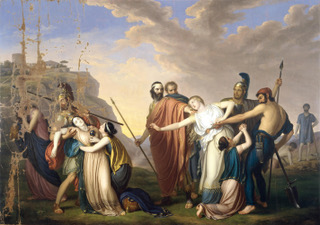
Antigone refuses. She knows that disobeying the king could cost her everything. She still chooses to bury her brother. It is easy to describe this as an act of rebellion against an unjust law. But I think there is something more intricate and intimate happening. Antigone is refusing to let a political label become the whole story of a human being. To Creon, Polyneices is a traitor. To Antigone, he is also her brother. And she refuses to believe that one identity can erase the other.
The power of Antigone’s decision comes partly from how ordinary it is. She is not trying to become queen. She does not want political office. She does not have an army behind her. She is not even attempting to persuade the whole city to agree with her. She wants to perform a final duty for someone she loves. That makes the conflict strangely personal.
Creon sees her actions through the language of politics. A citizen has disobeyed the ruler. A forbidden burial has taken place. His authority has been challenged. Antigone sees the same situation through the language of family. A brother has died. He needs to be buried. Both perspectives exist at the same time.
That is what makes Antigone so difficult to reduce to a simple story of good versus evil. Creon is not wrong to worry about the stability of Thebes. Polyneices really has fought against the city. But Creon’s political judgment cannot completely erase Antigone’s personal relationship with her brother.
A person can be condemned by a state and still be loved by a family. That distinction is at the heart of the tragedy. There is another reason why Polyneices’ burial matters: the dead cannot speak for themselves. Once Polyneices is dead, he cannot explain his actions. He cannot defend his name. He cannot argue with Creon’s version of events.
Someone else has to remember him. Creon wants the city to remember Polyneices as a traitor. Antigone wants to remember him as her brother. Neither memory is entirely detached from the circumstances of his life. But the question is not simply which description is factually correct. The deeper question is whether one political judgment should be allowed to determine everything a person means to everyone else.
This is where an ancient tragedy begins to feel unexpectedly close to our own world. People are constantly reduced to labels. A person can become a headline, a statistic, a political category or a public reputation. Once a label becomes powerful enough, everything else about the individual can disappear behind it.
Antigone asks us to resist that disappearance. She reminds us that a person can be more complicated than the name given to them by an institution. It would be comforting if Sophocles made the choice obvious. He does not.
Creon’s position is not entirely unreasonable. Thebes has just experienced violence, and he wants to establish himself as a ruler who will not tolerate betrayal. From his perspective, showing honour to Polyneices could undermine the very principles he is trying to protect. His concern is therefore not completely irrational.
His tragedy begins when concern turns into certainty. Once Creon decides that obedience is necessary for the survival of the state, disagreement starts to look like disloyalty. Anyone who challenges him appears to be challenging the authority of the city itself. And this is where his position becomes dangerous. A ruler needs authority. But authority without the ability to listen becomes something else.
Creon is given opportunities to reconsider. His son Haemon challenges his thinking. Other warnings reach him. Yet he continues to interpret resistance as a threat. He becomes less interested in whether he is right and more interested in proving that he cannot be wrong. That is a very different kind of power.
It would be equally easy to turn Antigone into a flawless symbol of courage. But she is not flawless. She is fierce, proud and unwilling to compromise. She knows what she believes and refuses to step away from it, even when doing so might save her. That makes her admirable, but it also makes her difficult. And perhaps that is exactly how Sophocles wants us to see her.
Antigone and Creon are very different, yet they share a dangerous quality: both become deeply attached to their own certainty. Creon cannot surrender his authority. Antigone cannot surrender her duty. Both believe that giving way would mean losing something essential. The tragedy grows from this inability to bend and there is an uncomfortable lesson here. Sometimes conflict is not created because nobody has a reason. It is created because everyone has a reason and nobody is willing to listen to anyone else’s.

Antigone’s position becomes even more striking because of who she is. She is a young woman confronting the ruler of her city. Creon does not merely see her action as a violation of his decree. Her defiance also challenges his assumptions about authority and obedience.
She has no official political power. Yet she manages to force the most powerful man in Thebes into a confrontation he cannot control. This is one of the quiet strengths of the play.
Antigone demonstrates that power is not always the same thing as authority. Creon possesses political authority. He can make decrees and enforce punishments. Antigone possesses something much less tangible: the conviction that there are things she cannot morally abandon. The two kinds of power collide. And the person with the official authority eventually discovers that authority has limits.
Perhaps this is why the burial matters more than it initially appears to. To bury someone is to say that their life deserves recognition. It creates a physical and emotional boundary between the living and the dead. It allows those who remain behind to mourn, remember and continue.
By refusing Polyneices burial, Creon tries to control that process. Antigone refuses to let him. Her act is therefore not simply about death. It is about memory. Who deserves to be mourned? Who decides? Can a government determine that someone is unworthy of remembrance? And can private love survive an official judgment?
These questions make Antigone much larger than a conflict between one woman and one king. They turn the play into a struggle over who has the right to tell the final story.
Perhaps the tragedy is not that Creon never receives advice. He does. The tragedy is that he hears it too late. By the time Creon understands the consequences of his decisions, there is nothing simple left to repair. Antigone is dead. Haemon is dead. Eurydice is dead. Creon remains alive. And that may be the harshest punishment Sophocles could give him. He has to live with the knowledge that his determination to protect his authority has destroyed the very things that mattered to him.
His final position is the opposite of where he began. At the beginning, he believes that a ruler must be obeyed. At the end, he understands that a ruler can also be wrong. But understanding arrives after the damage is irreversible.
It is strange to think that a play written more than two thousand years ago can still make a modern reader or audience uncomfortable. But perhaps that is because the problem at its centre has never disappeared. We still have laws. We still have governments. We still decide who is loyal and who is not. We still give people labels. And we still struggle to remember that a public identity is rarely the whole story of a human being.
Antigone does not tell us that every law should be broken. Nor does it suggest that every act of resistance is automatically noble. Instead, it asks us to pause before accepting the certainty of those in power – and perhaps before accepting our own certainty too.
Antigone’s greatest act is remarkably small. She refuses to leave her brother alone. She refuses to allow his final identity to be determined entirely by his political defeat. She refuses to let a decree erase a relationship.
And in doing so, she reveals something that Creon does not understand until it is too late: power can control what people are permitted to do, but it cannot completely control what they choose to remember.
That may be why Antigone continues to return to us. Every generation finds a different part of her story. Some see civil disobedience. Some see the conflict between divine and human law. Some see a struggle between the individual and the state. Others see a woman refusing to surrender her voice.
But beneath all these readings is the same quiet act. A young woman looks at the body of her brother and decides that someone else will not be allowed to determine what his life means to her.
Perhaps that is the enduring force of Antigone. Not that she defeats the king. She doesn’t. Not that she saves her family. She doesn’t. But that, for one brief moment, she refuses to let power have the final word. And maybe remembering someone is sometimes exactly that: refusing to let someone else tell you who they were.
©MansiJoon



You must be logged in to post a comment.