
with Caroline Lawrence and Lorna Lee
Can you give us a brief outline of what readers can expect from your story?
Caroline: It is a short retelling of Virgil’s Aeneid from the point of view of Aeneas’ faithful friend Achates… if Achates were A DOG not a Trojan warrior!
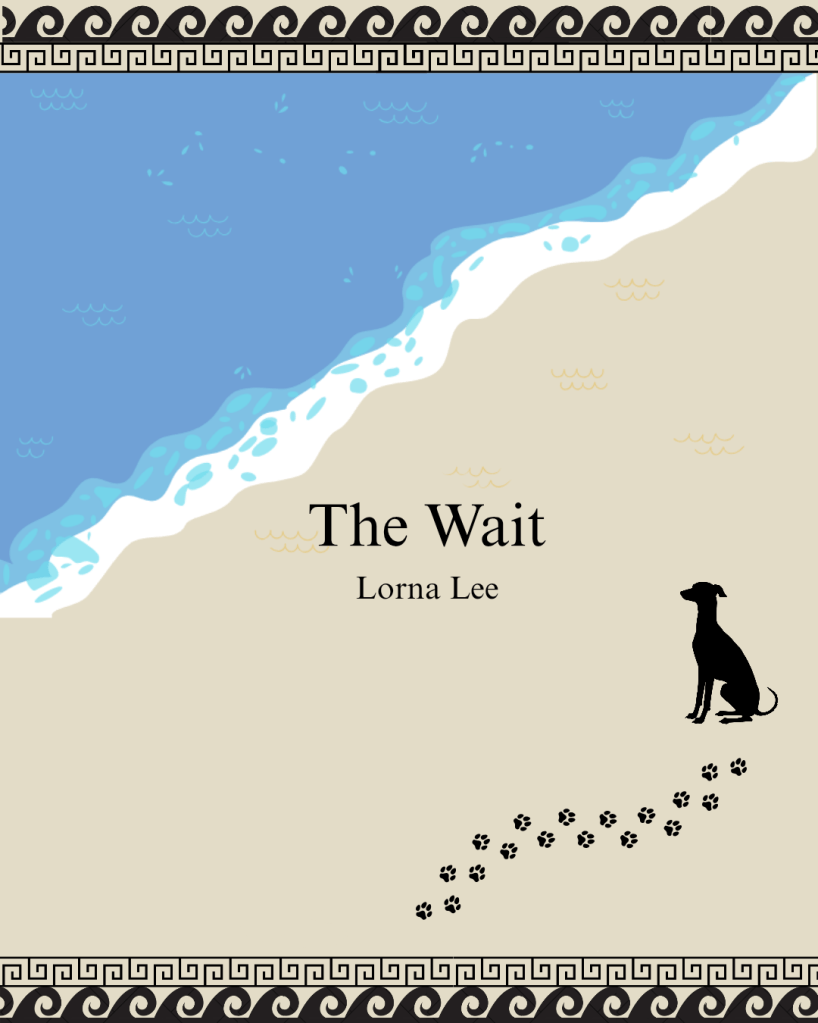
Lorna: The Wait is a reimagining of Odysseus’ twenty-year absence from Ithaca through the eyes of his loyal hunting hound Argos.
What drew you towards reimagining this tale through the eyes of a dog and why did you think this would be an interesting perspective to explore?
Caroline: In April 2024, I remember seeing a newly uncovered fresco from Pompeii, the so-called ‘black triclinium’ fresco. It showed the Trojan prince Paris face to face with beautiful Helen of Troy. Helen has a maidservant with her and Paris has a big mastiff lying at his feet. This marvellous hound is ‘breaking the fourth wall’ by looking out at the viewer with an expression of delightful worry as if to say, ‘I have a bad feeling about this!’ When I go into schools I often talk about the faithful sidekick as an archetypal character, and I wondered if this hound was Paris’ ‘faithful sidekick’… (Of course, I knew he wasn’t. In depictions of the Judgement of Paris, Paris is almost always shown with a dog, because a dog is an attribute of a shepherd, which was Paris’ job at the time.)
I had already written a couple of stories from Virgil’s Aeneid from other characters’ points of view (e.g. Nisus and Euryalus, and Camilla) and had long been thinking about doing a story from the point of view of Aeneas’ faithful sidekick Achates, about whom we know nothing except that he’s ‘faithful’. Suddenly it occurred to me, what if Aeneas’ faithful sidekick (i.e. Achates) was a dog? That was my lightbulb moment. I realised I could have lots of fun using smells and doggy motivations to retell the story of Aeneas.
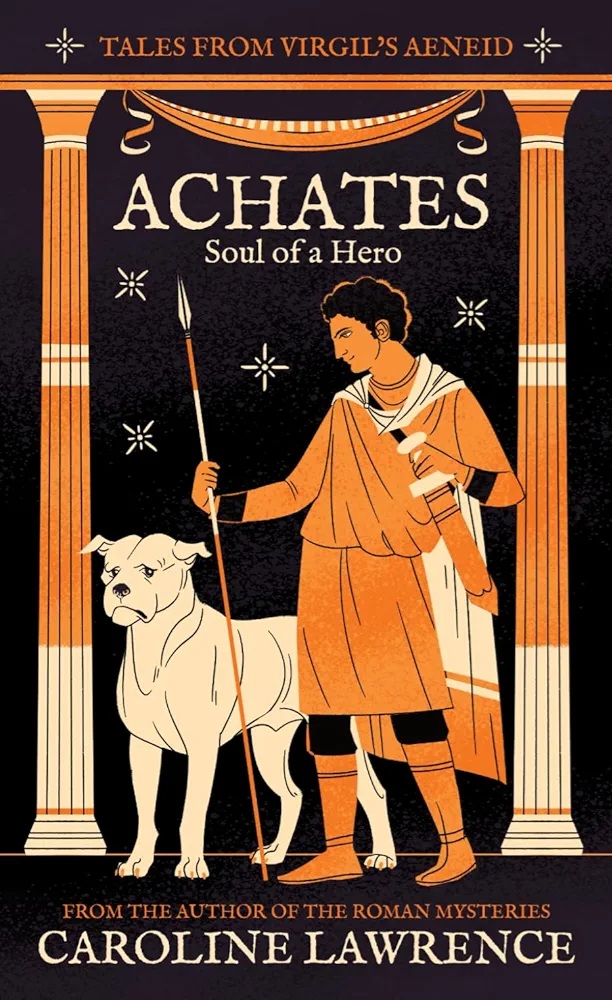
When I commissioned the brilliant Flora Kirk to do the cover, I asked her to use the mastiff from the Pompeian fresco as inspiration.
Lorna: Argos has not left me since I read the Odyssey for the first time (an experience many of its readers share) and, like Caroline, I knew I could have lots of fun playing with different smells and his uniquely doggy perspective. I was also fascinated by the number of lines and significance the poem devotes to a non-human and seemingly minor character, giving him a backstory and death formula reminiscent of the heroic warriors of the Iliad, as though the narrator themselves could not resist spending more time with him. Then when a dog called Darcy who was very big part of my family passed away last summer, Argos’ characteristics and the afterlife I imagine for him also became a way to memorialise her and say goodbye.
How did your doggy main character come to life and what were your biggest inspirations while constructing their personality?
Caroline: To make Achates come to life I just tapped into my deepest animal self, the part that’s always thinking about food! And I used observations gleaned from watching dogs and reading books such as The Last Family in England by Matt Haig. I used my imagination to dream up what each of the Olympian gods might smell like, as well as all the places Aeneas visits in his search for ‘a new Troy’.
Lorna: Many aspects of Argos’ personality and interactions with human characters were inspired by my Darcy memories. I also drew as much as possible from the biography we are given of Argos in Book 17 of the Odyssey, including his name – one reason why he does so much running is because one translation of argos is ‘swift’ – as well as my research into the history of dogs in the classical world – the first-person narration was actually inspired by an epitaph for a Roman dog called Margarita written from the canine perspective.
Do you have a favourite fact or quote that you discovered during your research process?
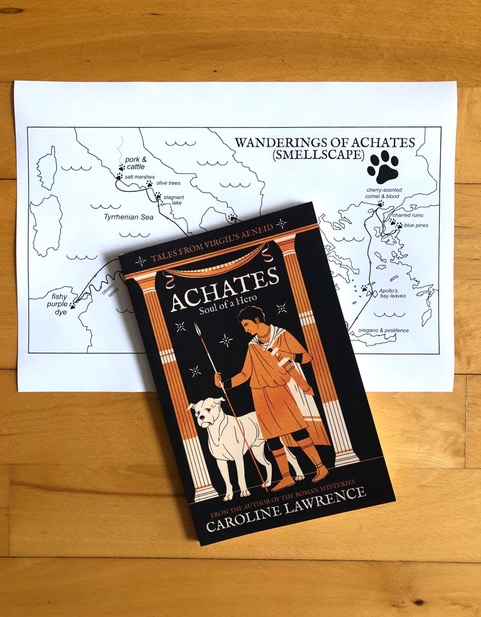
Caroline: My husband is a graphic designer. He and I had a lot of fun coming up with a ‘smellscape’ map of the Wanderings of Aeneas.
My favourite quote was one I came up with myself. Canem cano, ‘I sing of a dog’. It’s a mash-up of the Cave Canem mosaic and the opening lines of Virgil’s Aeneid.
Lorna: One of my favourite facts (which I picked up in Eirene S Allen’s excellent book The Epic Women of Homer) is that the Ancient Greek word for ‘loom’ histos can also refer to the mast of a ship, which I tried to evoke by describing Penelope weaving in nautical terms.
What was it like going from writing from a human to a canine perspective? Were there any aspects that you found particularly fun or challenging?
Caroline: It was huge fun writing from a dog’s perspective, although I actually identify as a cat! I had to keep reminding myself it’s all about smell, smell, smell. Also lifting your leg a lot to announce your presence and assert your authority.
Lorna: I really enjoyed coming up with doggy alternatives for human phrases, such as ‘one set of teeth’, rather than ‘one pair of hands’.
One of the biggest challenges was figuring out who Argos was speaking to. The reader? Himself? A muse (like Achates)? Nothing fit until I happened upon Jonathan Nolan’s short story Memento Mori, which is written in the second person, and, though my story is not, the repetition of the word ‘you’ made it suddenly click that Argos could be talking to a ‘you’ and who else would that ‘you’ be but Odysseus?
How much did the story and characters evolve from your first to final draft?
Caroline: I already had a clear idea of who Aeneas and Achates were. My characters hardly evolved at all, but I did have a revelation. It’s a love story about the love of a dog for their beloved owner.
Lorna: My idea of who Argos was and the scenes I wanted to explore also remained largely unchanged throughout the drafting process, except the addition of an extra beach scene set when Telemachus and Melantho are older (a suggestion from one of my lovely beta readers). Another significant difference was that Argos could not see gods in early drafts, just smell them! But my Argos does not have the same conception of gods as the human characters, which made it tricky to communicate what these strange inhuman smells were within the limits of a short story. It all became clearer once I lifted the veil…
Did you have any favourite scenes or descriptions to write? Or relationship dynamics that you found especially interesting to explore?
Caroline: For the scenes of Dido and Aeneas, I made Dido’s sister Anna into a faithful hound so that she could interact with Achates! I had fun writing the ‘love scene’ between the two dogs as their master and mistress make love in the cave. Of course, I tried to be tasteful as the book is aimed at teen readers!
Lorna: I loved incorporating Homeric-inspired descriptions! One example is the sparrow simile I use to describe Melantho playing as a child, inspired by the simile of ensnared birds the Odyssey employs to describe her execution (22.460–70) which I included to draw a contrast between those two moments.
Another favourite is the ‘growling/baying heart’ motif, inspired by Homer’s description of Odysseus’ heart growling within him (20.10–18) at the sight of the maids sneaking off to see the suitors. I find it really interesting how this evokes the idea that Odysseus has become animalistic in his outrage and liked to imagine that some of Argos’ spirit has passed into him.
Did your experience engaging with a classical text through this perspective shape the way you think about the original or your approach to your own writing?
Caroline: For the important passages I did close readings of the Latin to try to get the feel of Achates’ emotions. I love doing slow literal readings of Virgil and Homer. The ancient words paint pictures in my head and inspire many scenes and ideas. I can still ‘see’ Achates digging himself into the sand of the seashore as the Trojans and Latins meet in battle for the first time and as he sits wounded in the shade of an umbrella pine, watching his master go berserk with fury.
My favourite scene is the one in the opening chapter which you can read it for free on Amazon. As with Virgil’s Aeneid, we open with a terrible storm. Achates is telling the story in first person. He tells how his ‘master’ Aeneas embraces him to keep him from falling overboard. If you don’t know the premise, the final bit – when Achates licks his master’s face – is a fun shock.
Lorna: From a writing perspective, it encouraged me to think about how to effectively craft a compelling story through a character who is often subject to the whims of others. Ultimately I drew inspiration from Penelope, introducing moments where Argos takes his fate between his own teeth, such as the spilt wine incident, and portraying his wait itself as active.
Building on this, the scene between Argos and Penelope on the cliffs really highlighted the parallels between their situations for me. It is one reason I felt she would be frustrated in that moment, when she sees herself – at the mercy of cruel suitors with subtle tricks and waiting for her husband to return among her few forms of resistance – mirrored in Odysseus’ devoted dog.
Get yourself a copy of Achates by Caroline Lawrence here.
Read The Wait by Lorna Lee here.
Listen to Caroline discussing the Aeneid on The Classics Podcast.


You must be logged in to post a comment.