
‘Sing to me of the man, Muse, the man of twists and turns’ (The Odyssey, 1.1–2, transl. Robert Fagles)
Caleb Henry gives his review of Christopher Nolan’s recent blockbuster epic, The Odyssey:
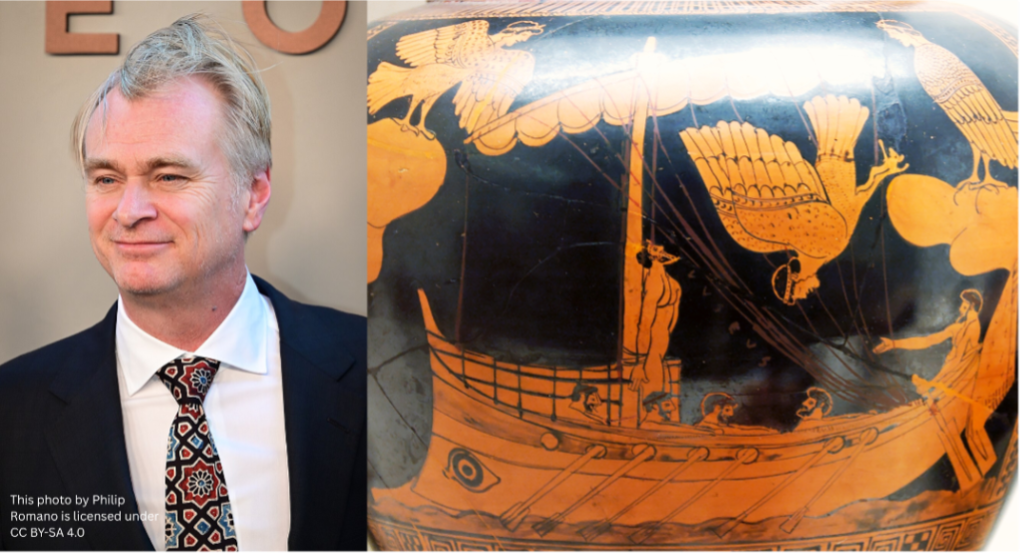
The works of Homer are tales which have inspired and engaged people for almost three thousand years, and as they called upon the muses to allow a story to be told, so too does Nolan invoke the epic poet to spin a new interpretation of the Odyssey. A much-anticipated film from a critically acclaimed director, a cast list brimming with A-listers, this seemed like a fantastic opportunity to engage a new audience and encourage curiosity about Classics, an area of study that often seems less accessible and intimidating to the average working-class individual.
Though I was initially hopeful, I do not believe that this movie will do anything but further stoke the Nolan cult following; as a student of Classics, it seemed a less-than-satisfying adaptation of a deeply meaningful and culturally significant story.
As mentioned, the cast list features heavy hitters such as Matt Damon, Anne Hathaway, Zendaya and Tom Holland, and yet it seems they were all given the same acting note. They were steered towards a very flat line delivery, which meant that little emotion was conveyed. At its core, the Odyssey is a story of homecoming, and all the complex emotions involved in going to war, being changed by conflict and becoming unmoored as a man for twenty years.
One strange character change is Odysseus’ relationship to his religion; he seems disconnected and uninterested in the practices his epic counterpart concerned himself with. He stands out compared to his men, portrayed as a man disillusioned with religion; I believe the phrase ‘your gods’ is used at least once. But Zeus himself praises the piety of Odysseus in Homer’s Odyssey, characterising him as a man who ‘excels’ all men in wisdom and his offerings to the immortal gods. It is pivotal to his characterisation, his belief in the gods and their vengeance, and it is what gives him a divine mandate to slay the suitors upon his return to Ithaca.
The tone that Nolan sets for Odysseus and his position within the Trojan conflict is reminiscent of accidental pro-war movies where the soldier is presented as a disillusioned man, someone whom the audience is intended to sympathise with – someone whom is as disgusted by the barbarity around him as we are. These movies disconnect the soldier from the atrocities he carries out, presenting him as a key victim in a conflict, absolved of sin in a way that doesn’t challenge the audience; they do not have to contend with the complexities of the soldier’s role in the war. Though not entirely the same, it reminded me of American Sniper, centring on a man who feels bad about the violence he commits and decentering the victims of a complex conflict.
These same character beats are present in Nolan’s Odysseus; he is part of the force that opens the gates of Troy, though thereafter he does very little in the sacking of Troy. He lies dejectedly on a set of stairs, watching as his men slaughter innocents; he is an observer.
The Odysseus of the Iliad is a capable and intelligent warrior, feared by the Trojans who cannot defeat him (4.490–500); he participates in slaughter when enraged (5.669–683) and enlists the help of the gods as he murders a camp of sleeping soldiers (10.460–70). Whilst ancient texts that detail the sack of Troy are lost to us, we can turn to other characterisations of Odysseus to understand the cultural understanding and artistic interpretation of his character. Euripides’ Trojan Women showcases a cruel Odysseus who takes part in the divvying up of loot after the sack of Troy; the key traits on display are his skill in manipulation, and the play leaves the audience with no doubt that this warrior has an incredible capacity for cruelty – even against the innocent women of Troy.
‘But come, all of us here put heads together now, work out his journey home so Odysseus can return’ (The Odyssey, Book One, 90–4)
The gods are notably absent from Nolan’s imagining of the Odyssey; the only immortals present are Calypso and Athena, though the divine status of both these characters is vague. In the case of Calypso, it seems that she has discovered the lotus and uses it to ease the torment that plagues Odysseus’ sleep. Yet there are no allusions to her powers; from recollection, there is no recognition of her dominion over the sea. Similarly, Zendaya is credited as Athena in the cast list, yet she seems to appear as the manifestation of Odysseus’ guilt over his role in the Trojan War. She is a judgmental and disapproving force in this movie, and it is later revealed that the form she takes is one of a priestess slaughtered in front of Odysseus.
No relationship between Athena and Telemachus is portrayed. However, he frequently compliments those he encounters as having ‘wise eyes, the eyes of Athena’; she does not appear as his advisor as she does in Homer’s Odyssey where it is the goddess who urges Telemachus to go forth to Pylos and Sparta to learn of his father’s whereabouts.
It seems unnecessary to have created an entirely new female character, seemingly Athena, to brutalise her in the aid of male character development. Especially when she has far greater autonomy in the Homeric epic, with Athena having chosen Odysseus as her avatar for her own ineffable reasons. Comments made during the press tour about the position of women in the epic raised some questions – I wondered in what way the women would be more fleshed out, made independent of their male counterparts or improved in some meaningful way.
I find the changes to the relationship between Calypso and Odysseus most upsetting – a chance to portray a male character of sexual assault, rare in blockbuster movies. Yet the context of their relationship is changed; the cruelty of Calypso is watered down, which is also symptomatic of the lack of divine representation. Greek religion was not anthropocentric; there is certainly a capacity to earn favour with the gods, but there is also the threat of ruin should they be spurned. It is part of the tragedy of the Trojan War, initiated by goddesses in competition with one another, exacting an immense blood price.
‘In the nights, true, he’d sleep with her in the arching cave – he had no choice – unwilling lover alongside lover all too willing… But all his days he’d sit on the rocks and beaches, wrenching his heart with sobs and groans and anguish, gazing out over the barren sea through blinding tears.’ (The Odyssey 5.170–5)
Odysseus expresses anger at being robbed of his memories with the lotus flowers but his entire characterisation in this adaptation is muted. Instead of tackling an opportunity to portray male victimhood and the horrible power of the gods and their complete lack of respect for the autonomy of mortals, the emotional weight of this relationship is completely lost.
A positive aspect of this movie is its portrayal of Circe, played by Samantha Morton, which changes the witch from a lover of Odysseus to a powerful yet frightened force who turns a group of threatening soldiers into pigs. She cites the abusive nature of travelling soldiers, who take advantage of hosts to satiate their appetites. The scene of their transformation is a disturbing one, involving the witch melding the men as though they are made from clay.
However, the positive changes that ‘antagonists’ experience end there. The Cyclops is a prime example of a character being robbed of their complexity, a creature who cannot articulate itself rather than someone that the wily trickster Odysseus puts effort into fooling. There is a call to his father during a scream, but the audio mixing makes this largely unintelligible. The Cyclops of Nolan’s vision is grotesque and lumbering, and the blinding of this demigod is an act of brute force rather than intelligence. Homer’s Odysseus must supplicate the Cyclops with wine; when asked his name, Odysseus offers the alias ‘Nobody’, which damns Polyphemus to suffering in solitude when he calls for his fellow Cyclops to save him from being murdered by Nobody. In the movie, the creature is blinded, and Odysseus arrogantly shoots an arrow at it as he and his men flee, inevitably condemning half his crew to their deaths.
I would not say that this movie is visually uninteresting; there are interesting design choices, if sometimes strange and historically inaccurate (see Agamemnon’s armour), but as a Classics student, it was missing what I love about the ancient world: colour. Simply put, this film’s palette consists of varying shades of grey and blue; there is very little warmth or vibrancy to the setting. Though it is from the Late Bronze Age, Knossos in Crete is a great example of the colours kings used to decorate their palaces. Though buildings in this period were primarily constructed with local marble and sandstone, the exterior would have had pops of colour; Knossos featured red columns which are visible from the outside, and it seems more would have been painted.
The interior of these palaces would have been where most attention was paid, with frescoes and reliefs forming centrepieces. Several were found in the palace of Knossos, portraying ceremonies and royalty in richly pigmented paints. To my knowledge, no such art exists in the palace of Ithaca, which seems to be of a similar size to Knossos. Similarly, many statues dedicated to the gods would have been painted; this would certainly be the case for a large temple to Athena in Troy, but the statue that Odysseus’ men decapitate is a plain white marble.
It is frustrating to have a film acknowledge that it is set during the Bronze Age, yet cling to familiar hoplite armour, which is out of place considering the age and nature of the fighting Odysseus and his men took part in. In 700 BCE, a revolution occurred in the tactics of battle and the armour soldiers wore; it is through the analysis of armour that we come to understand that battle became a more organised deed. Soldiers would cling to formation, and the style of the armour suited that, whereas the Odyssey contains a lot of individual skirmishes and chaos, which does not lend itself to this type of armour. The imagery and silhouette of the hoplite armour is iconic, but again, a chance to display something interesting and unique was passed up in favour of a more familiar armour.
Regarding the acknowledgement of its periodisation, this comes to us during the reunion between Penelope and Odysseus. The key twist concerns this looming threat of ‘the people from the sea’, who raid and destroy the lands they come across. It is theorised that plundering seafaring peoples are partly to blame for the Bronze Age collapse, as well as climate, drought, disease and internal rebellion. Perhaps it is pedantic, but to have Odysseus utter the words ‘our age of bronze is collapsing’ felt incredibly silly. A method of defining history which was only adopted in the nineteenth century feels so out of place, as out of place as Julius Caesar saying ‘in these years before Christ’.
‘Young men danced, whirling round to the sound of pipes and lyres, and women stood by the doors of their houses to admire the sight’ (The Iliad, 18:490–500, transl. Peter Jones with E V Rieu)
A great triumph of this movie is the score by Ludwig Göransson. It utilises the aulos, lyre, drums, and vocals to create a unique and authentic sound. The main theme ‘Odysseus’ heavily features the aulos, in a haunting and melancholic tune which is far more complex than any character portrayed in this film.
In short, Nolan’s The Odyssey is certain to appeal to his fans; it is undeniably a Nolan movie. But it is far from an Odyssey movie.
©CalebHenry


You must be logged in to post a comment.