
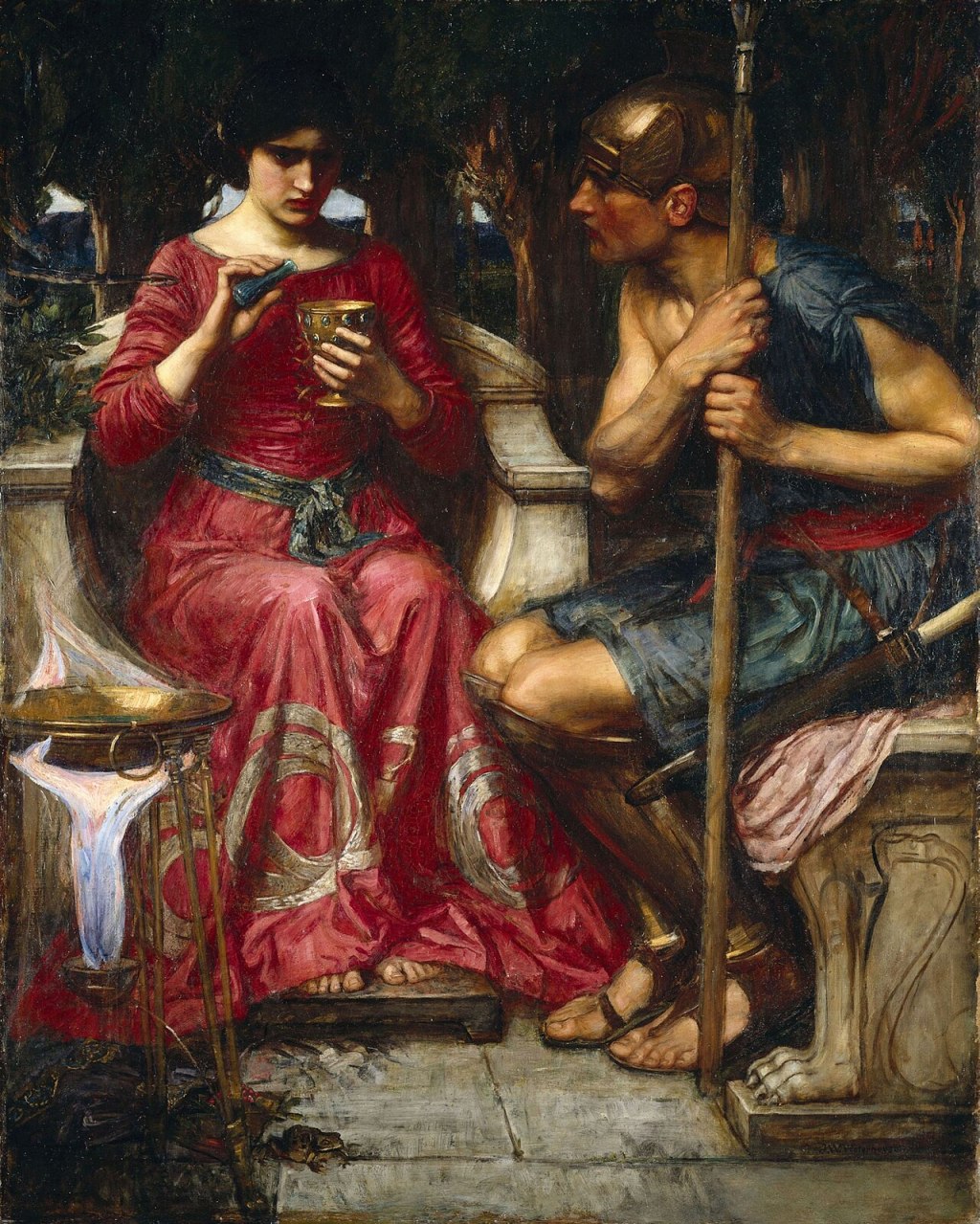
Jason and Medea (John William Waterhouse, 1907)
by Olivia Saunders
I have been looking forward to reading Natalie Haynes’s take on the story of Medea for a long time – I believe since shortly after the publication of Pandora’s Jar in 2020, when I both read her analysis of the character and learned of her plans to write a novel about Medea. She often mentions the tragedy by Euripides as one of her favourite texts and one which highly encouraged her passion for the field of Classics. This book, therefore, was highly anticipated, and after the success of A Thousand Ships and Stone Blind, had a lot to live up to.
No Friend to This House does not disappoint. It is a brilliantly written book which, like all Haynes’s work, shows her deep understanding and love of the classical world and its mythology. Although I attended the book launch, where Haynes spoke about the Argo and the Golden Fleece, I was still surprised – as many readers might be – to find that the novel is about the whole story of the Golden Fleece and the Argonauts as well as Medea. She doesn’t make her first appearance until around 40% into the book! This was a real shock, since Medea as a character is such a huge draw, and an interest of Haynes, but works brilliantly to tell a richer and more intricate story.
One of the most distinctive aspects of Haynes’s work is her use of many different, sometimes very unconventional, perspectives. In No Friend to This House, I counted 35 different perspectives, some in first person, some close-focus third person, and a few in direct address to the reader. This variety of perspectives allows a far more nuanced story to be told, since the reader can see the situation from almost every angle and is not limited by any single character’s knowledge, and permits dramatic irony as we shift perspectives towards characters who know less.
Using these different perspectives also allows Haynes to create an incredibly intricate plot as we learn the smallest details – the section ‘Interlude: The Child of Theophane’ is particularly interesting in this way, as Haynes uses a cyclical structure of solely female perspectives to tell the story of the golden ram which would become the Golden Fleece. This section appears to me to follow many classical models and use classical techniques; it is almost an epic digression in and of itself, and the little-known female characters whose perspectives she writes from show her doctrina. Some might suggest that this section is unnecessary to the story, but it in fact reflects on the themes of being a mother and a daughter which are so important throughout.
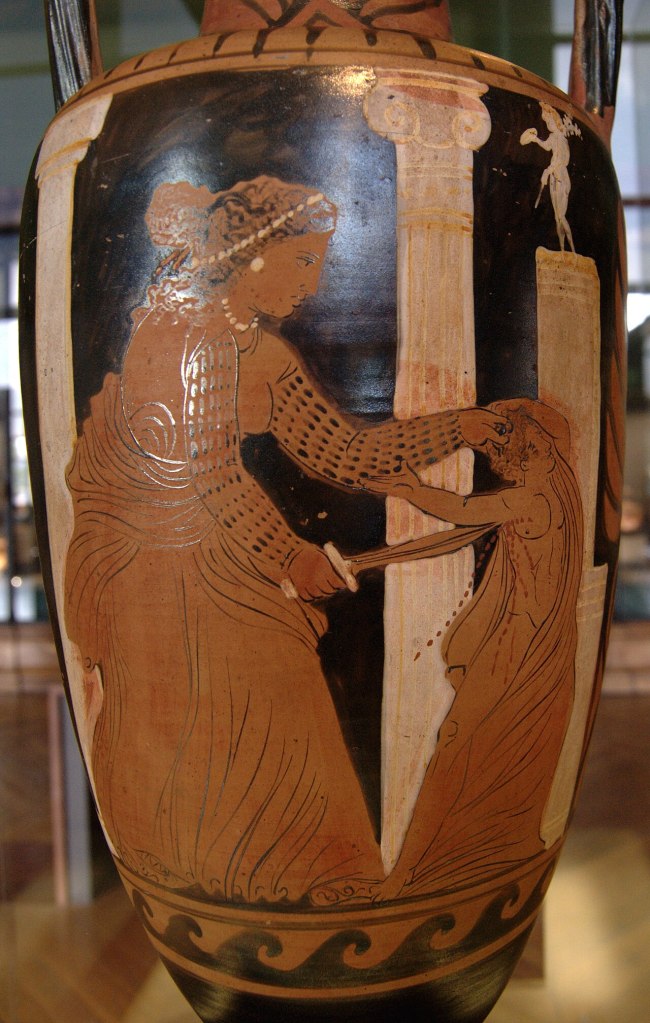
Medea’s murderous acts (4th century BCE amphora)
There are those who criticise ‘feminist retellings of Greek mythology’ for simply being stories about a woman, but Haynes’s feminism pervades this book. Yes, it is largely about a woman, Medea, but Haynes also writes from the perspectives of very many other women and goddesses, considering their stories and emotions in detail. Feminist themes are so important throughout No Friend to This House, which focuses on the roles of mothers and daughters, and how women are forced into marriages and motherhood, and into staying in them. Haynes brilliantly shows how all these different women deal with the positions they are put in, and how some – like the Lemnian Women and Medea – push back, but also the consequences for this. Even the very last section of No Friend to This House reveals how patriarchy is embedded into the very grammar system of Ancient Greek (and most modern gendered European languages), which as a feminist linguist I found very vindicating.
Something that scholars have long noted is the difficulty of characterising Medea in telling her whole story. Apollonius’s innocent maiden hopelessly in love seems a completely different person from the vengeful but sympathetic witch of Euripides, and it is very difficult to bridge the gap between them. Haynes navigates this difficulty extremely well; her Medea remains consistent in character and voice throughout, gradually shedding her naivety. Her discovery of how different Greek norms are from Colchian norms, and Jason’s view of the Colchians as barbarian, is a heartbreaking and wonderfully well-written arc, and the way she tries her hardest to fit into the role of a Greek wife and appease Jason is horribly ironic to those who know what will inevitably happen to her.
Some of Haynes’s choices in order to make Medea more sympathetic slightly disappoint me, although they are very understandable from a storytelling perspective, as I particularly enjoy female characters being allowed to be unapologetically evil – I am thinking particularly of her treatment of the death of Apsyrtus. However, each of these choices, although not what I would have preferred to see at that point, add to Medea’s arc and story as a whole.
As always, Haynes’s treatment of the gods in No Friend to This House is brilliant – a large part of my EPQ was about the way Haynes portrays the gods in her work, and their petty and amoral selfishness is always such a joy to read in her voice. Aphrodite and Hera are in particular integral characters in this novel, both largely motivated by vengeance, and their cruelty and disregard for mortals creates a very interesting perspective to read from.
In her author’s note, Haynes describes this book as ‘about an empty space where a man should be’. This is an intriguing way to think about the story, and truly reflects the selfishness and ambiguity of Jason in No Friend to This House. His perspective is not included, and so we the readers cannot know what he is thinking. The glimpses we get into his mind in sections from the point of view of the Argo as a whole and of Medea, who seems to know him best, suggest that he is constantly dissembling and often half convinces himself of his own lies. Haynes skilfully crafts a character whom the reader cannot help but dislike, self-centred and inconstant from the beginning, but equally charming and skilled at rhetoric so it is impossible to blame those taken in by him.
No Friend to This House is an incredible piece of classical reception. The story is incredibly well researched – Haynes translated the whole of Euripides’s Medea in preparation for writing it, and syncretises a huge variety of sources and versions of different parts of the story. Beyond this, what makes No Friend to This House truly unique is its fusion of ancient and modern writing styles. A recurring point is analysing the ancient rhetorical idea that the ship was at fault for everything that happened, as well as the grammatical considerations raised in the last section, and Haynes often makes use of digression, monologues and direct address in a distinctly classical way. Knowledge of the classical texts Haynes references is not necessary for enjoying No Friend to This House, but the more that you know the richer your experience of this book will be.
Whatever your level of classical study, you will enjoy No Friend to This House, and it is my hope that like all of Haynes’s work, and the many other classical stories being published, it will continue to bring more interest to the field of Classics and create future classicists from different backgrounds.
©OliviaSaunders


You must be logged in to post a comment.