

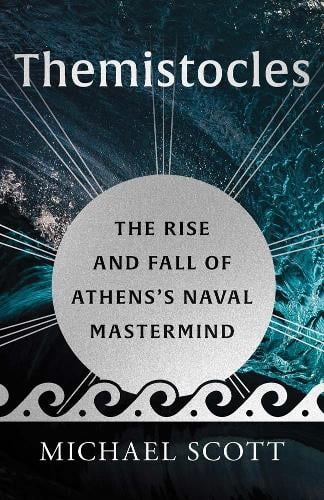
Following the release of his latest book, Themistocles: The Rise and Fall of Athens’s Naval Mastermind, in February 2026, we spoke with our President Professor Michael Scott about his journey in writing this fascinating biography of an iconic character from ancient Greek history.
Do you remember your earliest encounter with the figure of Themistocles? What were your initial impressions?
I was lucky enough to study some ancient Greek when I was at school, and I remember his name being brought up as historical context to our study of Aeschylus’ Persians – a play about the Greek victories over the Persians at Salamis and the subsequent shame of the Persian king. So I was introduced to Themistocles as the great schemer and the brains behind the greatest of Greek victory. I was introduced to him as the hero, which I think is how most people are introduced to him through this – his most infamous moment in the spotlight.
What fascinated you so much about Themistocles that led you to write this book?
I was approached by Yale University Press Ancient Lives series editor James Romm to suggest someone I wanted to write about. Initially that was a tough ask – there are so many great characters from the ancient world to write about! But the more I thought about it, the more Themistocles felt to me like a character who needed a biography. This was for two main reasons.
Firstly, I think most people hear about Themistocles in one of two contexts: his role at Salamis and then his role in building Athens’ walls (which still to this day are known as the Themistoclean walls). But what else happened to him? Well, it turns out a lot! So a biography would help make the picture of him much fuller than just these two moments.
Secondly, because Themistocles is often represented as a hero, a one-dimensional legend – Thucydides, for example, lists him as the (joint) most illustrious Greek of his time. But delving into his life revealed a constant series of rises and falls, of successful decisions and failures, of needing to reinvent himself in order to become relevant again, and a process of reputation re-building after his death that is quite extraordinary. A biography felt like a great way to give not just a fuller picture of his life, but a more realistic one – of both the ups and the downs.
What key takeaways would you like readers to get out of this book?
This book is dedicated to my two-and-a-half-year-old son Wilbur (not that he will be reading it for quite some time!). I dedicated it to him because I hope that the book – alongside informing people about a fascinating period in Athenian, Greek and Persian history – also helps people realise how lives are really lived: filled with ups and downs, successes and failures. That is the case however much posthumous reputation-building whitewashes that rollercoaster ride to only remember certain ups (or in our modern world how much social media curates our impressions of others as if they are only having the time of their lives). I want people to learn about the ancient world, but also take comfort that famous, successful lives are just as full of rises and falls as everyone else’s. That’s a lesson I hope my son will remember throughout his life.
This is the first biography of an ancient character you have written. How did you find that process different from writing your previous books?
Writing this book has been interesting in all sorts of ways. Firstly, I signed the contract to write this book back in 2021, on the understanding that I had another book to write first (X Marks the Spot). Then when I did start writing it, I was writing it as my wife and I moved home and I started a new job on the Executive Board of the University of Warwick, which meant lots of upheaval and new working routines. The first draft was completed a week before my son arrived, and I have edited it during his first year of life (and quite a few sleepless nights!). So despite this being the shortest book I have ever written, it’s actually taken me the longest time to write and seen me through some of my own highs and lows!
But what that much longer gestation time has meant has been a much longer time to mull and reflect on Themistocles the character, which I think has been a very good thing. There are significant ancient biographies of Themistocles (and a number of his contemporaries) by Plutarch, Cornelius Nepos and others, so we are not lacking in ancient impressions of him (although we would love a few more contemporary sources!). For me the interest has been in establishing the facts, understanding all the historical and social contexts in which Themistocles was operating, and then reflecting on how Themistocles might have felt and reacted, imagined and reimagined his path as he navigated through an incredibly turbulent and exciting period of history.
Do you have a favourite fact you learned while writing Themistocles?
I think it’s incredible that Persian Kings after the era of Xerxes, Artaxerxes and Themistocles would attempt to woo future Greek dissidents to the Persian court with the promise that they would be just as well treated as Themistocles. Themistocles became the benchmark for how a Greek could be accepted into, and respected at, the Persian court, which is pretty extraordinary for someone who is simultaneously remembered for having been the architect of Persian defeat at Salamis.
Has your opinion of Themistocles changed in any ways over the course of writing the book?
Despite having studied ancient Greek history for some time, even I was not aware of all of the ups and downs, rises and falls in Themistocles’ career (and how much we must therefore admire his grit and determination to keep reinventing and rebuilding himself), or indeed quite how dramatic his posthumous reputation recalibration was. He died a condemned traitor in Greek eyes and yet, within little more than a decade, was a Greek and Athenian hero. The degree to which the ancient Greeks – and particularly the ancient Athenians – rewrote their memory of recent history to suit their present has been absolutely incredible to unravel.
Themistocles was once asked if he would rather be an Achilles or a Homer. Which would you rather be?
I’m a history writer, so I would always vote for Homer. I wonder if Themistocles – with the benefit of hindsight and an awareness of how much his eternal reputation depended on the way in which the Athenians chose to rewrite and re-remember history after his death – would, if given the choice again, vote for Homer (over Achilles, whom he initially picked). The pen just maybe is mightier than the sword!
If you were to write another ancient biography, who would be your number one pick?
I would not want to write about another politician or military figure, so perhaps something more located in the social, cultural and religious world. I would love to write the biography of someone who has been misunderstood, or misremembered. But equally, I am always fascinated by people who travel and experience different cultures and worlds: Megasthenes – the first formal ambassador from the Seleucid Empire to the court of King Chandragupta Maurya at Pataliputra in India in the late fourth century BCE – is one of my all-time favourite characters.
Thanks Michael!
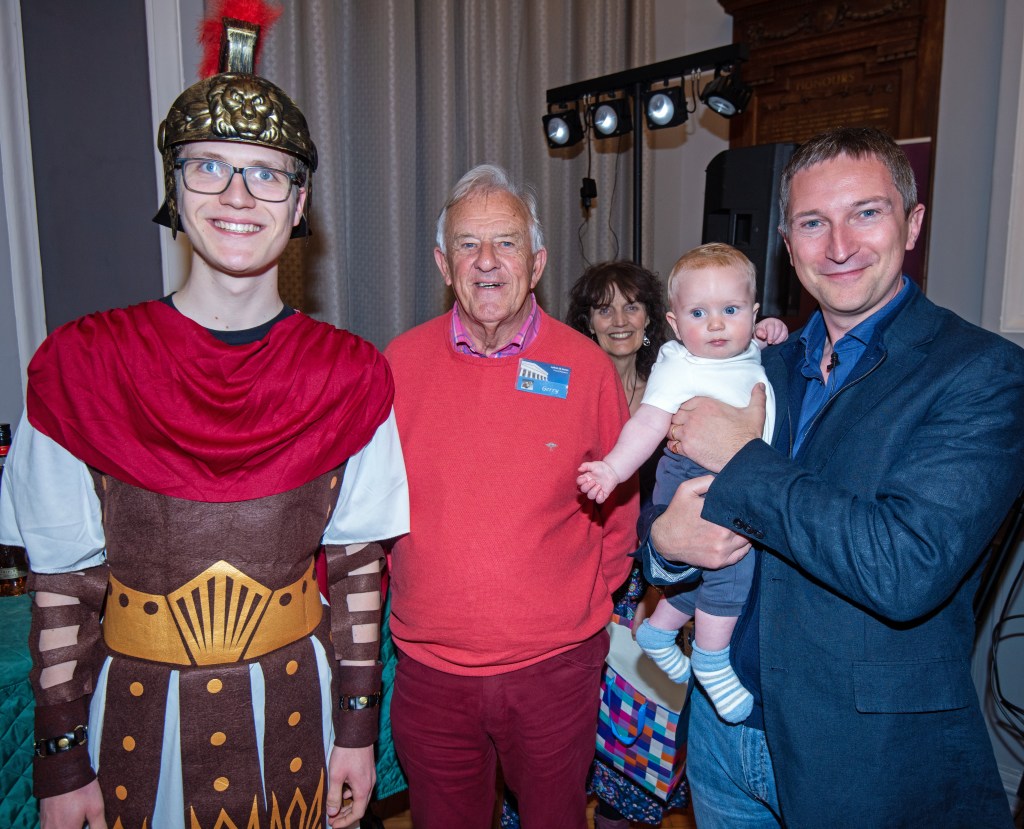
Interview conducted by Declan Boyd (pictured below in Roman garb, with fellow committee members, Michael and his young son Wilbur!).


You must be logged in to post a comment.